Oh, sure, I edited two of the covers featured here but I don't want you to think that makes me special. (It's my perfect pitch and ability to smell cardamom from a thousand yards away that does.)
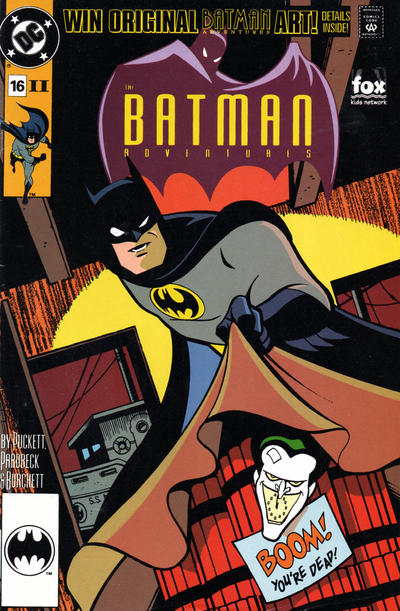
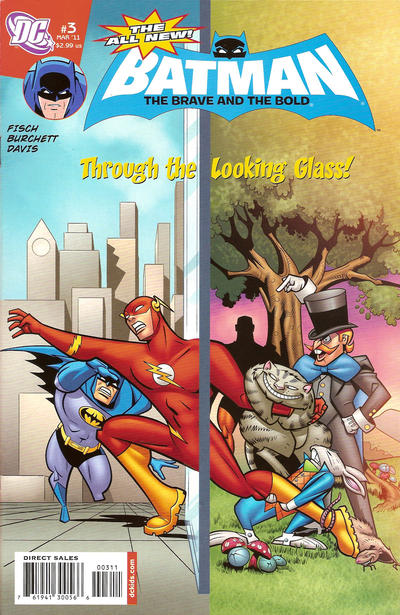

Oh, sure, I edited two of the covers featured here but I don't want you to think that makes me special. (It's my perfect pitch and ability to smell cardamom from a thousand yards away that does.)

Way back when, after Gotham City was devastated in a massive earthquake (see Batman: Cataclysm and Batman: No Man’s Land in 2000) it was written off and abandoned by the US government in a spookily prescient foretaste of what would happen to New Orleans after Hurricane Katrina hit in August 2005. Amidst the rubble, a number of heroes struggled to protect the innocent. One of these was a brand-new incarnation of Batgirl.
As the crisis ended and a semblance of normality returned to the battered metropolis, the new heroine got her own series and a mentor in the form of Babs Gordon, the wheelchair-bound crime-fighter called Oracle, who was also the first Batgirl.
The new operative is an enigmatic problem. Raised in utter isolation as an experiment by martial arts super-assassin David Cain, she cannot communicate. Part of the process creating Cassandra Cain was depriving and overriding her language centres in an effort to make combat her only communication tool. An apparent runaway, she was briefly adopted by the Batman as another weapon in his never-ending battle, before the more humane Oracle becomes her guardian and teacher.
In this first paperback/digital volume – spanning April 2000-March 2001 by collecting #1-12 of the monthly series and first Annual – the new Batgirl is trying to find her way, bereft even of the ability to learn, whilst revelling in the role of defender of the helpless, but her development as a human being threatens to diminish her capacity as a weapon, and the mystery of her past would indicate that she is possibly a two-edged sword in Batman’s arsenal…
In a bold experiment, initiating writers Scott Peterson and Kelly Puckett eschewed the standard format of individually titled stories to craft a continuous string of high action, deeply moving episodes which saw the neophyte street warrior battle the dregs of Gotham City while attempting to adapt to a life where not every person was her enemy. Fast, furious, frenetic, visually expressive incidents (illustrated by Damion Scott with inkers Robert Campanella & Coy Turnbull) are interspersed with flashbacks to her lethal and cruel formative years with Cain pitting her against assassins and worse, while keeping a stunning secret of her natal origins all for himself…
Spellbinding, overwhelmingly fast-paced and terse to the point of bombastic brevity, this is a breakneck, supercharged thrill-ride of non-stop action that still manages to be heavily plot-based with genuine empathy and emotional impact. Truly superb comic storytelling which should be on every fan’s wish-list or bookshelf.
 |
| portrait by Brian Stelfreeze |
Denny had first written the Batbible sometime in the late 80's—it says 1989, which is the year the Michael Keaton/Jack Nicholson/Tim Burton film came out, but it's possible he wrote a draft earlier. It definitely includes the script for "The Man Who Falls," the fantastically concise and powerful origin story Denny and Dick Giordano created for a special trade paperback Secret Origins collection DC put out shortly after the Batman movie took the world by storm, collecting otherwise previously published origins for the likes of Superman, Wonder Woman, Flash, Green Lantern and the Martian Manhunter.
The Batbible was updated sporadically afterward, at least during the seven largely magical years I spent working with Denny. It went from being a much-photocopied document to being copied to a floppy disc to being copied to an in-office Mac to finally, presumably, being emailed, in the days when that was still somewhat new and hi-tech. It usually had a whole lot of artwork attached, including a set of drawings of things like the Batcave and Wayne Manor that Graham Nolan had drawn for us.
In 2012, 14 years after I'd officially stopped working with Denny and a full 19 years after I was no longer actually his assistant, Denny emailed me to ask me if I had a copy of the Batbible I could send to him.
Of course I did. The number of irreplaceable items I'd lost track of since those amazing days of helping helm Batman do not bear thinking of. But the Batbible? Of course I had a copy of that. Sure, it was a half dozen iterations of operatating systems out of date, but I still had the raw data. And, sure, it took me a few hours of work to be able to extract it from those old old oh so old versions of software, but what, I'm going to not keep track of the official writing of What Is and Is Not Batman by the great Dennis O'Neil? I don't think so.
So. Herewith I present to you (most of) the mid to late 1990s edition of The Batbible by Dennis O'Neil. I've nixed some of the characters, since some of them—the mayor of Gotham (Krol), for instance—proved somewhat ephemeral and I have to pay extra if I go over the character count.
***
***
There are nine and sixty ways
To sing the tribal lays
And all of them are right.
-Rudyard Kipling
He's had a number of personalities in his fifty years of existence. He's been a grim avenger; a swashbuckling fantasy adventurer; a cheery solid citizen; a Sherlockian ratiocinator; and on television, a self-mocking comedian. Because he has inhabited that vast, unboundaried mirror-world known as Popular Culture, where realities shift from day to day and change is the only constant, the Batman has had to remake himself every decade or so or risk almost certain extinction. He has survived and, in the mirror-world, that is an achievement.
I'd like to think that, despite the many guises he has assumed in the past five decades, there has been one constant: his soul. Now, when we're discussing a fictional character, "soul" doesn't mean quite what it means when we're discussing your next door neighbor. (You and your neighbor, and Father O'Malley, and Rabbi Goldberg, and Lao Tse, and Zoraster and Martin Luther and Mohammed would probably also disagree about the exact definition of the word, whether applied to real or unreal people, but that's irrelevant.) Let's agree that in this context "soul" means whatever prompted the creation of the character. A Jungian, or a student of mythology, might argue that our hero is an archetype--an idea or image that's part of everyone's psyche--and I'm not sure I'd disagree. If that's the case, he wasn't created so much as discovered, and then adapted to fit the needs of the moment. Mythologists tell us that's how it usually works.
But if he is an archetype, he should have had earlier incarnations. Other denizens of the mirror would certainly do. Superman is a modern version Gilgamesh, Hawkman is Dedalus, The Flash is Apollo, The Hulk is Hercules--it could be a pleasant rainy day diversion for a trivia freak with a scholarly bent to complete the list. But if we look for earlier versions of our man, we find little or nothing that can be labeled "hero." We're successful if we search for him among the villains: the demons, the bloodsuckers, the were-creatures, all the dwellers of dark places, all those who shun the light. Look at Dracula, squint a bit, and you see The Batman.
This is a good guy?
Well, yes. He has that half-century's continuous publication to prove it. But I wonder about how the metamorphosis worked, exactly. What changed the dark-dweller from monstrosity to savior, and why has he remained popular for so long?
Start with this: The Batman is nothing if not urban. So maybe the answer is in how people came to regard cities. Once, cities were heavens: bulwarks against wild beasts, savages, all the manifestations of a cruel and capricious nature. But by Dickens' time, cities were recognized as themselves cradles of evil. The devil doesn't live in a bog miles from civilization; the devil lives upstairs. The devil is Rosemary's Baby. That being so, where is a citizen safe? Certainly not in New York, nor in New York's mirror-world counterpart, Gotham. I've long believed that Batman's Gotham City is in Manhattan below Fourteenth Street at eleven minutes past midnight on the coldest night in November. Take a walk. What is that in the doorway? The man in the black jacket, the one crossing the street there--is he wearing something over his face? Why is he running? And--oh my god-- he's coming this way. Now imagine this: the runner speeds past you and strikes down the person in the doorway, who is your worst enemy, who is insane, who has an ax. The runner is Batman. What I'm suggesting is that we have coopted the grimmer archetypes, embraced them, declared them, with all their ferocity and relentlessness and inhuman competence, our allies. One of the names we call them is Batman.
Why? Well, it's been a pretty rough century, and it's probably getting rougher. It might be easier to coopt a devil than to believe in an angel.
Of course, we're not glum all the time. We don't always want to be shaking hands with the devil. Optimism and pessimism seem to be cyclic. The reason Batman survived and other saturnine worthies--particularly his immediate forerunner, The Shadow--did not may be the adaptability I mentioned earlier. If the decade favors the Protestant Virtues--citizenship, family, patriotism, good old church-going American Decency--our man becomes the Batman of the Fifties. If the decade is questioning such virtues, our man caricatures them as did the Sixties Batman. The secret of this adaptability is simple: many different artists and writers and editors have worked on the Batman. Although he was created by Bob Kane and Bill Finger, dozens of later craftsmen, including me, produced his stories. We were all reacting to the moment, to whatever was shaping our lives at the time, and the lives of our editors and publishers and readers, and our reactions in turn shaped him.
Which is not to say the stories bear no individual stamp; they do. Writers like Steve Englehart and Doug Moench have given us a normal, healthy Batman with a romantic streak. Others, such as Frank Miller and Jim Starlin, have presented Batman as a tormented obsessive. There hasn't been much latitude in the graphic representatives--he's always had the bat silhouette, the flowing cape and the dark colors--but the Batman has certainly looked different from decade to decade. Neal Adams' approach is generally considered the best--some say definitive. Neal's rendering is basically realistic. He once told me, "If Batman existed, he'd have to look the way I draw him." But it is heightened realism or, to borrow a term from German painters and Latin American novelists, "magic realism." In Neal's work, people and things are recognizable, but idealized and subtly exaggerated, given a unique drama and purity. It is a style particularly appropriate to a character who, while a superhero, is not superhuman: who manifests both an ideal of human perfectibility and a reflection of human terror.
Having said all that, I must reiterate that the character as a whole is a consensus. No one individual guided the Batman, and so he could not be the victim of one individuals getting old, cranky, isolated, out of touch. That maybe antithetical to great art, but it is almost a condition of folklore--a myth is a story that generations have agreed on--and any character who's been visible for fifty years in virtually every medium has to be a folk hero. He's been molded by too many disparate things not to be.
Back to matter of his soul. Can a composite even have a soul? Sure. The Batman archetype is the creature of darkness who serves the common good, the devil on an angel's mission; that's the image always at the center of the stories. It is what individual artists and writers react to, either embrace or deny, or even lampoon, but can never totally ignore. Unless the humanity has a sudden, unprecedented attack of sanity, and we need no longer fear the darkness, it will probably keep him popular for at least another fifty years.
— Dennis O'Neil
January 1989
***
Happy birthday, Denny. Thank you for...well, other than my wife and children, pretty much everything good in my life.


It was the first script I'd ever read. I was thrilled to be reading a script by a writer I admired, thrilled to know I was maybe only the third person in the world to read this brand new Batman story. And it was, typically, a very good one. I went back to Denny and told him so.
Denny nodded, then leaned back in his chair. "The plothole around how they discovered the maguffin didn't bother you?"
I debated trying to pretend I'd caught the plothole but decided instead to admit that I'd totally missed it. And yet once he brought it up, yeah, there it was.
I asked if he was going to send it back for a rewrite.
He shrugged. "It's a pretty easy fix."
He grabbed a pen—a red one, of course—crossed out a few words in one line of dialogue, added a new line of dialogue, and handed the script to me to send to the penciller.
Then he held up the pen and said, "Before you pick up the red pen, make absolutely sure you're changing it to make it better, and not just to make it different, or the way you would have done it."
Then he turned away and started reading something else. I was dismissed, having gotten my first—and still one of the very best—lessons in editing.
[That photo up above—found online somewhere—was taken in the office Denny was occupying when I first interviewed with him, and yet I remember having the red pen conversation in a corner office he later had a few doors down; memory is a strange, strange beast.]


PAGE FIFTEEN
Panel One
Batman and Clayface stand with Mister and Mrs. McKee and a doctor--let’s make this doctor female and either African-American or Asian, whichever you feel like, Tim. She wears a coat that clearly shows she’s a doctor, but perhaps the STAR Labs logo can be on there, to differentiate her from the Fort Kisco docs?
DOCTOR: ...and since the floor temperature can be dropped in a matter of seconds, Clayface can be frozen into immobility at any time.
BATMAN: I don’t think we need to worry about another escape attempt.
Panel Two
Batman’s opening the door that leads into another room. Clayface is looking sullen..
CLAYFACE: Great. So you can keep me here, but you can’t force me to do whatever it is you want.
BATMAN: Why don’t you explain that to Tommy?
Panel Three
Closeup on Clayface, his face going slack upon seeing Tommy.
CLAYFACE: Who’s Tommy and why do I...
CLAYFACE: Oh.
Panel FourHere, impossibly, is what Tim delivered:
Twoshot of Clayface and Tommy. Tommy’s ten and due to a genetic problem, he looks very much like a smaller, paler version of Clayface, only worse--his molecular structure is breaking down, causing him, in effect, to melt. The two of them look at each with a touch of horror and lot of recognition and resulting sadness.

PAGE SEVENTEEN
Panel One
Clayface holds out his right arm and pushes up his sleeve with the other. We can see that from the wrist up to the elbow it’s goopy and Clayface-looking. Tommy looks on.
Panel Two
Now Clayface’s arm solidifies and looks quite normal. Tommy looks happily amazed.
Panel Three
Tommy hold out his arm and grits his teeth and squints his eyes, clearly trying the same thing. Clayface looks somewhat anxiously expectant.
Panel Four
Tommy lets his arm and the rest of his body drop, very disappointed: this seemed to be his last hope, and now it’s gone too. Clayface looks quite sad.
PAGE EIGHTEEN
Panel One
Clayface grabs Tommy’s arm and holds it with his arm, which is now goopy again. Clayface smiles reassuringly.
Panel Two
They both concentrate like hell, Clayface playing it up for all it’s worth.
Panel Three
Closeup on Clayface’s and Tommy’s eyes as Tommy concentrates and Clayface stares at Tommy intently.
Panel Four
Pull back for them both looking down at Tommy’s arm which is now the arm of any ol’ ten year old. Tommy looks like he was just told he’s taking batting practice with Ken Griffey Jr, while Clayface’s pleasure is a little more muted if just as deep; he’s purty durn stoked here.


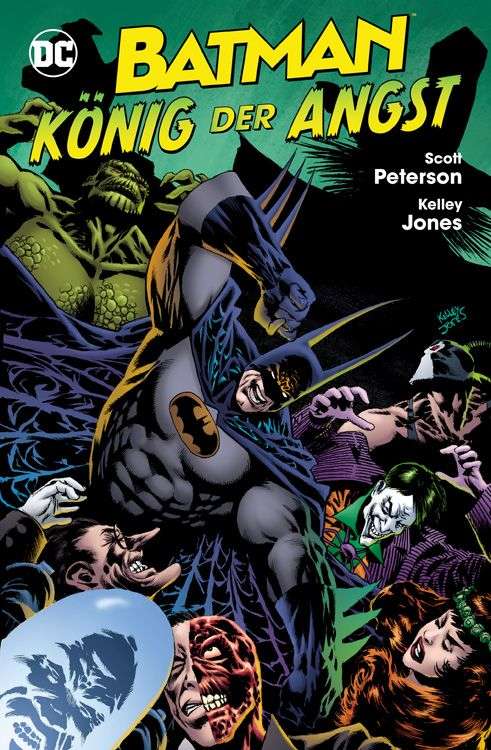
Kelley Jones just gets better with age, honing his abstract style to do more storytelling alongside visuals that put Bats and his rogues gallery into perspectives no other creator has thought to try. The covers alone are worth picking this one up, and the insides are even better. Some of the panel layouts and way Kelley works off Peterson's cool concept--what if Scarecrow drugged Bats enough to get him talking--were so good I just stared at them for several minutes. And that's not to underplay Scott's work here as a writer--he really digs into the psychological concepts of Batman, even if I disagree with some of the answers we find in the series. I don't read a lot of DC material right now, but I'm glad I got to this one, it's highly recommended and requires no prior context beyond a general knowledge of the characters.I admit, I thought it was pretty swell, too.




If you have manga fans, give them this one! The artwork is very manga-inspired, and the storyline is fast-paced, with car aerodynamics and explosions aplenty. There’s good world-building – I like the idea of the Roman Empire’s enduring and not moving past this whole entertainment-or-death business. It’s a popular dystopian theme, from The Running Man to The Hunger Games, and fits where we are as a media-obsessed, “if it bleeds, it leads” society. Axl is an interesting character, with his stoicism and the big moral choice ahead of him. In a society where everyone is corrupt, the good guy becomes the outlaw – and the team owner and the emperor himself are all in, trying to sway Axl. Piston is Axl’s foil, made of passion where Axl represses everything. Her bad decisions get her tossed off one team, and leave her future with Team Apollo pretty tenuous until she starts to harness her own power and channel it in more positive ways. But having a bit of that wild streak also means pulling out some big risks, and that may be what Team Apollo needs.
Truckus Maximus is a fun read, and should be popular with tweens and young teens. I’d like to see this as an animation.Hey, me too!


I’m crazy. I swear to God I am.Those second and third examples? They're on the same page.
I swear to God I’m crazy. I admit it.
I’m crazy. I swear to God I am.
I swear to God I’m a madman.

When “Help!” came out, I was actually crying out for help. Most people think it’s just a fast rock ‘n’ roll song. I didn’t realize it at the time; I just wrote the song because I was commissioned to write it for the movie. But later, I knew I really was crying out for help.I mean, how much more obvious could it be? And yet no one listened.

Batman: Kings of Fear is a series of 6 mini-issues focusing on The Dark Knight’s innermost fears and motivations… An almost Catcher in the Rye mission split with several references to A Christmas Carol: The Scarecrow takes Batman on a tour through what has happened and what might have been.
[I]t’s a simple premise, but things get complicated when Batman has to reflect upon his life as a crime fighter. The dialogue hums nicely as does the flow from issue to issue. (I always worry about that when reading these types of mini-comics.)
A seriously fun ride that may be a bit deeper view of Scarecrow and Batman than I’ve ever seen. One I’ll be recommending to many.I mean. Salinger and Dickens? I'll take it.


