|
| portrait by Brian Stelfreeze |
When I became Dennis O'Neil's assistant editor in 1991 (I think), I was given many responsibilities—one of which was to send a copy of The Batbible out to any creators working for us on Batman for the first time.
Denny had first written the Batbible sometime in the late 80's—it says 1989, which is the year the Michael Keaton/Jack Nicholson/Tim Burton film came out, but it's possible he wrote a draft earlier. It definitely includes the script for "The Man Who Falls," the fantastically concise and powerful origin story Denny and Dick Giordano created for a special trade paperback Secret Origins collection DC put out shortly after the Batman movie took the world by storm, collecting otherwise previously published origins for the likes of Superman, Wonder Woman, Flash, Green Lantern and the Martian Manhunter.
The Batbible was updated sporadically afterward, at least during the seven largely magical years I spent working with Denny. It went from being a much-photocopied document to being copied to a floppy disc to being copied to an in-office Mac to finally, presumably, being emailed, in the days when that was still somewhat new and hi-tech. It usually had a whole lot of artwork attached, including a set of drawings of things like the Batcave and Wayne Manor that Graham Nolan had drawn for us.
In 2012, 14 years after I'd officially stopped working with Denny and a full 19 years after I was no longer actually his assistant, Denny emailed me to ask me if I had a copy of the Batbible I could send to him.
Of course I did. The number of irreplaceable items I'd lost track of since those amazing days of helping helm Batman do not bear thinking of. But the Batbible? Of course I had a copy of that. Sure, it was a half dozen iterations of operatating systems out of date, but I still had the raw data. And, sure, it took me a few hours of work to be able to extract it from those old old oh so old versions of software, but what, I'm going to not keep track of the official writing of What Is and Is Not Batman by the great Dennis O'Neil? I don't think so.
So. Herewith I present to you (most of) the mid to late 1990s edition of The Batbible by Dennis O'Neil. I've nixed some of the characters, since some of them—the mayor of Gotham (Krol), for instance—proved somewhat ephemeral and I have to pay extra if I go over the character count.
***
A BRIEF BATBIBLE: NOTES ON THE DARK NIGHT DETECTIVE
What This Is
Herewith, in brief, everything the present editor thinks new writers and artists need to know to do basic Batman stories. The continuity is, perforce, always changing, but the backstory, props, locales and major characters are graven in stone, at least until the next editor ungraves them. So, while you should check with the one of the editorial staff on current stuff, what follows should give you what you need to know about the history and milieu and, to use a very fancy word, the mythos.
Who He is
Bruce Wayne, son of Dr. and Mrs. Thomas Wayne. Age: early 30s. Heir to a large fortune estimated at nearly 500 million dollars.
Wayne money is old money. The family has been in Gotham since Colonial times. there are large plots of prime, downtown acreage estate that belong to the estate. Income from these alone would provide Bruce with a handsome living, but he also profits from Wayne Industries and Wayne tech, private-sector firms that specialize in cutting-edge practical applications of research.
Bruce is handsome, and he can be charming, and he projects intelligence. But he also seems unfocused. Those who know him privately lament that he's never found himself, never quite grown up, has never even wondered what his potential might be, much less how to realize it. It is known that he spent his adolescence and early manhood drifting around the world, auditing university classes here and there, occasionally even enrolling for a semester, without ever getting close to a degree. He was the quintessential dilettante and shrewd Gothamites feel he still is. His only real talent, they say, is in hiring exactly the right people to manage his various enterprises.
He is not married. He's been seen with dozens of attractive females, but he's never had a serious affair. He favors women who, like himself, are underachievers. It is assumed that he has occasional flings--the phrase "one night stand" comes to mind--but his dates tend neither to confirm or deny the assumption. If they ever compared experiences, they'd learn that an evening with Bruce is always the same: dinner, a show or an appearance at some social or charity affair, and early leave-taking, a plea of illness or a busy tomorrow, a quick kiss on the cheek with a promise to call, and a silent telephone thereafter.
Where He Lives
The Wayne Manor that was drawn by Dave Mazzucchelli for Batman:Year One. The post-Civil War era mansion seems to be equipped with state-of-the-art security, as befits the residence of a very wealthy man; actually, the gear is state-of-the-art plus. The building is on about 40 acres of ground outside the city limits, but not so far outside that the Gotham skyline is not clearly visible from the mansion. There is an access road--lane, really--from the house to a county blacktop which leads directly to a freeway which, in turn, terminates in downtown Gotham City. There is another road at the rear of the estate, on a private game preserve, that also connects to the blacktop. This is the route of the Batmobiles (which see.) Television cameras, hidden in bushes, posts and mounds of dirt, are spotted around the grounds, commanding a view of the whole area. There are also motion detectors, microphones, heat sensors--every high-tech tool imaginable to provide maximum, though clandestine, security. It looks like Wayne Manor is as open as a baby's smile. But nothing larger than a grasshopper can move around it without being detected. Beneath the house is--
The Batcave
This is a large, natural cavern accessible from two places in Wayne Manor: a door disguised as a grandfather clock in the library and an emergency exit behind a bookcase in the master bedroom. When the clock's hands are set at 10:42--the hour and minute Bruce Wayne's parents were murdered--the hidden door unlocks. There is also a larger egress in a hillside which opens onto a road in a private game preserve adjoining the manor grounds; this is camouflaged to make it look like part of the natural terrain. Wayne has equipped the cave with a mainframe computer with a huge database and access to other computers throughout the Wayne empire and throughout industry and law-enforcement world wide; a chemistry lab; a physics and ballistics lab; a machine shop; a garage; an arsenal of non-lethal weapons; a gym; a specialized library; climate control devices; a communications center; a small museum; and an emergency generator. There are several alarms--motion and heat detectors and pressure alarms--camouflaged as rock formations throughout the cave. If anyone--or anything--penetrates the outer security, a buzzer will sound in the working area of the cave and what sounds like a particularly noisy refrigerator will be heard in the house above.
The cave is vast. Not even Wayne himself has explored it completely. There are thousands of bats living in it and a small subterranean stream in which freshwater fish can be found. A long, narrow tunnel leads to the an abandoned subway tunnel about two miles from the cave's central chamber; this provides Batman with quick access to the city if surface travel is undesirable.
His Associates
ALFRED PENNYWORTH is the Wayne butler, housekeeper, cook, amanuensis, paramedic, repairman and doer of whatever needs doing. He is probably the most capable man in North America, with a range of achievements that is astonishing: he can do everything from cook a gourmet meal to fix a carburetor. His special talent is for mimicry: he can perfectly imitate Bruce Wayne's voice and the lower-pitched voice Wayne uses as the Batman, an ability that is often useful. His only lack is imagination; he is a follower who needs the leader he has found in Wayne. When he speaks in his own voice, his diction is gramatically precise and just a bit fussy. Beneath his proper British exterior, Alfred is a sensitive and loving man--the perfect surrogate father. He is generally quiet, but he has a keen, sarcastic sense of humor that he sometimes directs at his employer when he feels Bruce is behaving unwisely.
ROBIN, Batman's young partner, is Tim Drake, actually the third Robin. The first, Dick Grayson, left Bruce to become the costumed crimefighter known as Nightwing. The second, Jason Todd, was killed in an explosion after defying Bruce and going alone after a murderer. As for Tim: He is everyone's ideal younger (or older) brother. He is intelligent--he is Robin because he deduced that Bruce was Batman and then made himself useful--but he is not a "brain." He is athletic without being a jock. He is respected by the macho kids in school, but he chooses to spend most of his time with the nerdier crowd, youngsters who'd rather punch keys than halfbacks. He is, unlike Bruce, an active and sincere dater; he has a steady girlfriend to whom he is as committed as a 14-year-old can be. And unlike his two predecessors, he does not consider himself a "laughing young daredevil." Because he was trained by many of the same masters who trained Bruce himself, he is expert in combat and an excellent gymnast. But he never eagerly enters into confrontations and when he does, he makes the fullest use of the weapons and safeguards built into his costume. He is most useful to Batman in surveillance situations and as a computer hacker; he has a better understanding of computers than anyone in Gotham with the possible exception of Oracle (which see.) Tim is a wealthy version of a latch key kid. He was neglected by both his parents until a couple of years ago when his mother was killed and his father badly disabled by kidnappers. The father, Jack, has partially recovered, but still has only a perfunctory interest in his son. Tim is largely left to his own devices, answering only to a housekeeper, Mrs. Macilvanie, which suits his activities as Robin. The Drake estate adjoins the Wayne property. Tim can access the Batcave from his father's ground through a gimmicked cistern. He also has a vehicle, a modification of Detroit iron he calls "the Redbird," which is stored in an unused shed on the Drake property. (As Tim, he has a valid driver's license because his father is impaired and a state law allows underage drivers in such situations.)
LESLIE TOMPKINS is a medical doctor who nurtured Wayne after his parents were murdered. She operates a free clinic, supported by Wayne funds, in an area known as Crime Alley. Philosophically, she adheres to the ideas of Ghandi and Dorothy Day; she believes in non-violence and the perfectibility of man. So she can not approve of Batman's methods. But she recognizes that he does more good than harm and, in any case, he is doing what he has to do. Does she know Bruce's secret? Nobody, including Bruce, is certain.
JAMES GORDON is the tough, incorruptible police commissioner. A former beat cop and detective, originally from Chicago, he rose to his present position despite opposition from the city's once-corrupt political establishment. He is a no-nonsense law and order man, in many ways Leslie's Tompkins direct opposite. Thus he approves of what Batman does, and does feel the masked man is a great help in maintaining order in Gotham, though he is uneasy about Batman's vigilante status. He does not know Batman's true identity! This is because he does not choose to know it; if he did, his life would be complicated, his code of morality compromised, and a weird but genuine friendship impossible.
Gordon has a niece whom he raised as a daughter--
BARBARA GORDON. Barbara has been a librarian, politician and even, briefly, a crimefighter. Several years ago, she was paralyzed from the waist down by a killer's bullet. After floundering for a time, she found a unique use for her education and training, and adopted a new identity, that of ORACLE. As Oracle, she is able to supply answers--to almost any question. She has a secret headquarters adjoining her apartment, built with Wayne money, which is the most complete information center on Earth. Tens of thousands of books, maps, directories, diaries, encyclopedias, journals, microfilms, phonograph records, tapes, computers and databases--these are the tools of her self-created trade. She speed-reads every major newspaper and magazine published in English, and hundreds in other languages, and remembers virtually everything she sees. Very few people know Oracle exists, and fewer still know how to reach her. There is a direct line from her quarters to the Batcave, giving Batman and his inner circle access to her at all times. Other potential clients can contact her by placing a coded message on an Internet bulletin board. Batman and selected criminalists get her services free. Others, on those rare occasions when she chooses to accept their assignments, pay exorbitantly.
HARVEY BULLOCK is a sergeant with the Gotham City police. Some feel he is a diamond in the rough; others exclude the "diamond" from their descriptions of him. He is the quintessential old-line street cop--crude, violent, overbearing, with little patience for the rights of the accused. Bullock thinks due process is for sissies. He is in his late forties, lives alone in a two-room apartment in a deteriorating part of the city. He seems to subsist solely on junk food, particularly doughnuts, and he smokes at least a dozen cheap cigars a day. He is anathema to most civic leaders, but they have to admire his courage and effectiveness. His fellow officers respect him, but few completely trust him and fewer still like him.
The rest of the GOTHAM CITY POLICE DEPARTMENT is not admirable. Poorly paid, virtually untrained--there is nothing in the budget for what are considered "nonessentials"--these men and women are largely recruited from the otherwise unemployable. Many of them are cops because they like guns, nightsticks and flaunting authority. Their equipment is mostly obsolete (except for their sidearms; Krol managed to find funds for new 9mm. semiautomatics) and badly maintained. The crime laboratory, for example, is bench, a microscope and a fingerprinting kit stuck in the back of an evidence storage room Personnel consists of one man who got a Master's in chemistry in 1968 and hasn't read a text since. Gordon does the best he can with what he's got, which isn't much. Without his energy and leadership, the police would be totally ineffective and the streets would be anarchy.
His Character
First, let us agree that Wayne/Batman is not insane. There is a difference between obsession and insanity. Obsessed the man surely is, but he is in the fullest possession of his mental and moral faculties. Everything with the exception of his friends' welfare is bent to the task he knows he can never accomplish, the elimination of crime. It is this task which imposes meaning on an existence he would otherwise find intolerable.
He is tough, but not brutal. He uses violence willingly and often, but never to excess, and never with pleasure. He does not enjoy it. And he never kills. Let's repeat that for the folks in the balcony: Batman never kills. The trauma which created his obsession also generated in him a reverence for that most basic of values, the sacredness of human life. If he was not consumed with the elimination of crime, he would not be the Batman. And if he did not consider human life inviolable, he would not be the Batman, either.
He is probably the best martial artist alive, and one of the best gymnasts. He hones these physical skills with daily workouts in the Batcave gym.
He is strong and athletic. A 550 pound bench press would be no particular problem. He can run 20 miles in a little over two hours, and swim an equivalent distance and time.
He eats sparingly and well. His is a balanced diet that an Olympic decatheloner would approve of.
He is brilliant, with an IQ comfortably in the genius numbers.
He is trained. An autodidact. He has traveled all over the world auditing classes and speaking to men who have knowledge he needs. He has total recall, which means he remembers everything he's read, and he's read a lot; speed-reading is one of the first skills he acquired. His learning, however, is limited. His knowledge of the liberal arts is slight--only what he's picked up in passing-- and his knowledge of the sciences is largely limited to the practical. So he knows very little about particle physics, but everything about ballistics. He probably cannot explain molecular bonding, but he knows how to test for every known poison. He's spent little time looking through a telescope and much time looking through a microscope. He is conversant with every theory of criminal behavior, but might not be able to explain the differences between Freud and Jung.
He is celibate. Any kind of sexual involvement would take thought and energy away from his mission. He appreciates women, even admires them, but he cannot afford intimacy.
He is compassionate. His determination to stop crime is exceeded only by his compassion for crime's victims. He can never forget that once he was a small boy weeping over his murdered parents.
Bruce or Batman
Which one is genuine, Bruce Wayne or Batman? Answer: Batman. Wayne has become part of his tool kit, an identity he finds useful. Wayne's wealth and social position give him entry into the city's center of power where he can acquire information. The Bruce Wayne he has created allows him to exist in civilization without being bothered much by its obligations.
His Gear
The utility belt is a streamlined carryall. Some of the compartments house keys and money, a small flashlight-- items he will always need. The rest are filled with things he anticipates needing for the particular case he's involved in. Thus, if he has reason to believe he'll be doing forensic work, he might carry fingerprint powder, a magnifying glass, a camera.
The Batmobile is actually several vehicles. All are capable of speeds in excess of 120 miles per hour (some can go more than 140) and all are fully computerized, state-of-the-art, able to respond to a limited number of voice commands. They are all linked via cellular phone connections to the computers in the cave, allowing Batman to access information while speeding around the city. Windows are polarized, one way glass. Tires are self-sealing. Everything possible is bulletproof. Most carry a compact thermite charge which will melt them to slag if any unauthorized person tries to enter them.
Batarangs are high-impact plastic boomerangs used as weapons.
Batman has a plaited, polymer rope wound around his body or coiled on his belt. This light, strong line is useful for everything from climbing to binding captives.
The costume differs according to weather and the needs of the moment. It is designed to be both theatrical--theatricality is part of the Batman's arsenal--and practical. It disguises him, of course. The mask subtly alters the shape of his face and the cape makes it difficult to judge his exact build. The light, flexible material, designed like a circus acrobat's costume allows him maximum freedom of movement. Dark coloring allows him to blend into shadows, a technique he learned from Japanese ninja. He has experimented, and continues to experiment, with various types of body armor. He's unsatisfied with any he's tried; either they impede movement or they're too light to be effective. Occasionally, though, he wears a heavy cape able to withstand the impact of anything short of a .357 magnum slug. His chest plate is armored and some of his capes are weighted to serve as weapons. All costumes are equipped with a voice communication link to the cave.
His City
Gotham is a distillation of everything that's dark, moody and frightening about New York. It is Hell's Kitchen. The Lower East Side. Bed Stuy. The South Bronx. Soho and Tribeca off the main thoroughfares at three in the morning. Georgraphically, it is a port city somewhere in the northeast with a population of approximately 7,500,000, a reasonable drive from New York. Architecturally, it is unique, and that is not a compliment. The buildings in the core of the city are grim and windowless, a legacy of the city's founder (and Bruce's ancestor) Solomon Wayne, who believed cities should be fortresses. After Solomon died, Gotham fell prey to robber barons and their tame politicians who made New York's Tammany Hall look like a Girl Scout camp, creating a tradition of corruption that continues today. It is a problem, Bruce Wayne confesses, that is beyond his powers, though the solving of it is definitely on his long-term agenda.
Writing His Stories
It is necessary to devise plots which use many if not most of the skills and attributes outlined above. Batman is a detective, but not of the genteel ilk-- no Hercules Poirot or Nero Wolf, but rather a Marlowe or Continental Op times ten. We should achieve a balance between ratiocination and action, neglecting neither, but perhaps emphasizing the latter. Stories should above all, move. Batman should never do something sitting that he can do running or leaping or jumping off a rooftop. Exposition and explanation should always be integrated with action. Talking heads are to be eschewed.
Villains should be larger than life, and preferably grotesque. The Joker and Two-Face are perfect examples of Batman bad guys; they wear their villainy on their faces and they represent archetypical traits (Joker: anarchy and chaos: Two Face: the dichotomy between good and evil that exists in most human beings.) And they are both natural antagonists to a hero like the Batman. Keep them in mind when creating new baddies and you won't go far wrong.
We can do every kind of story except cosmic science fiction and fantasy. Batman should never visit Mars or Middle Earth. But this does not exclude the supernatural. Ghosts and even such nasties vampires and poltergeists are fair game, provided they are used infrequently, judiciously and placed in stories that incorporate other Batman elements.
IMPORTANT NOTE: Until further notice, we should avoid any religious iconography in art or any ethnic and/or religious references in plot and copy. When religion or ethnicity is absolutely crucial to a given story, be creative-- use analogues; do not use real people or creeds. We should also live without strong language. It is easy to write certain four-through 12-letter combinations and startle/shock /outrage the reader. It is harder to achieve the same effects with language your mother taught you, but it can be more satisfying, too. Let's travel the high road for a while and see where it takes us.
Drawing His Stories
Much of what applies to the writing applies equally to the graphics. Artists are encouraged to remember mood, action and grotesquerie. Panels should be textured and backgrounds should not be slighted; in any Batman series, Gotham City is a character, and should be treated as such. Clarity is essential. Readers should never wonder which panel to read next, nor have any doubt about exactly what's happening here.
As with the writing, cheap shots in the art should be avoided. Sex and gore are often better suggested than depicted, for the same reason that many consider radio drama superior to television drama; suggestion allows the audience's imagination, the most powerful of dramatists, to do our work for us.
***
There are nine and sixty ways
To sing the tribal lays
And all of them are right.
-Rudyard Kipling
He's had a number of personalities in his fifty years of existence. He's been a grim avenger; a swashbuckling fantasy adventurer; a cheery solid citizen; a Sherlockian ratiocinator; and on television, a self-mocking comedian. Because he has inhabited that vast, unboundaried mirror-world known as Popular Culture, where realities shift from day to day and change is the only constant, the Batman has had to remake himself every decade or so or risk almost certain extinction. He has survived and, in the mirror-world, that is an achievement.
I'd like to think that, despite the many guises he has assumed in the past five decades, there has been one constant: his soul. Now, when we're discussing a fictional character, "soul" doesn't mean quite what it means when we're discussing your next door neighbor. (You and your neighbor, and Father O'Malley, and Rabbi Goldberg, and Lao Tse, and Zoraster and Martin Luther and Mohammed would probably also disagree about the exact definition of the word, whether applied to real or unreal people, but that's irrelevant.) Let's agree that in this context "soul" means whatever prompted the creation of the character. A Jungian, or a student of mythology, might argue that our hero is an archetype--an idea or image that's part of everyone's psyche--and I'm not sure I'd disagree. If that's the case, he wasn't created so much as discovered, and then adapted to fit the needs of the moment. Mythologists tell us that's how it usually works.
But if he is an archetype, he should have had earlier incarnations. Other denizens of the mirror would certainly do. Superman is a modern version Gilgamesh, Hawkman is Dedalus, The Flash is Apollo, The Hulk is Hercules--it could be a pleasant rainy day diversion for a trivia freak with a scholarly bent to complete the list. But if we look for earlier versions of our man, we find little or nothing that can be labeled "hero." We're successful if we search for him among the villains: the demons, the bloodsuckers, the were-creatures, all the dwellers of dark places, all those who shun the light. Look at Dracula, squint a bit, and you see The Batman.
This is a good guy?
Well, yes. He has that half-century's continuous publication to prove it. But I wonder about how the metamorphosis worked, exactly. What changed the dark-dweller from monstrosity to savior, and why has he remained popular for so long?
Start with this: The Batman is nothing if not urban. So maybe the answer is in how people came to regard cities. Once, cities were heavens: bulwarks against wild beasts, savages, all the manifestations of a cruel and capricious nature. But by Dickens' time, cities were recognized as themselves cradles of evil. The devil doesn't live in a bog miles from civilization; the devil lives upstairs. The devil is Rosemary's Baby. That being so, where is a citizen safe? Certainly not in New York, nor in New York's mirror-world counterpart, Gotham. I've long believed that Batman's Gotham City is in Manhattan below Fourteenth Street at eleven minutes past midnight on the coldest night in November. Take a walk. What is that in the doorway? The man in the black jacket, the one crossing the street there--is he wearing something over his face? Why is he running? And--oh my god-- he's coming this way. Now imagine this: the runner speeds past you and strikes down the person in the doorway, who is your worst enemy, who is insane, who has an ax. The runner is Batman. What I'm suggesting is that we have coopted the grimmer archetypes, embraced them, declared them, with all their ferocity and relentlessness and inhuman competence, our allies. One of the names we call them is Batman.
Why? Well, it's been a pretty rough century, and it's probably getting rougher. It might be easier to coopt a devil than to believe in an angel.
Of course, we're not glum all the time. We don't always want to be shaking hands with the devil. Optimism and pessimism seem to be cyclic. The reason Batman survived and other saturnine worthies--particularly his immediate forerunner, The Shadow--did not may be the adaptability I mentioned earlier. If the decade favors the Protestant Virtues--citizenship, family, patriotism, good old church-going American Decency--our man becomes the Batman of the Fifties. If the decade is questioning such virtues, our man caricatures them as did the Sixties Batman. The secret of this adaptability is simple: many different artists and writers and editors have worked on the Batman. Although he was created by Bob Kane and Bill Finger, dozens of later craftsmen, including me, produced his stories. We were all reacting to the moment, to whatever was shaping our lives at the time, and the lives of our editors and publishers and readers, and our reactions in turn shaped him.
Which is not to say the stories bear no individual stamp; they do. Writers like Steve Englehart and Doug Moench have given us a normal, healthy Batman with a romantic streak. Others, such as Frank Miller and Jim Starlin, have presented Batman as a tormented obsessive. There hasn't been much latitude in the graphic representatives--he's always had the bat silhouette, the flowing cape and the dark colors--but the Batman has certainly looked different from decade to decade. Neal Adams' approach is generally considered the best--some say definitive. Neal's rendering is basically realistic. He once told me, "If Batman existed, he'd have to look the way I draw him." But it is heightened realism or, to borrow a term from German painters and Latin American novelists, "magic realism." In Neal's work, people and things are recognizable, but idealized and subtly exaggerated, given a unique drama and purity. It is a style particularly appropriate to a character who, while a superhero, is not superhuman: who manifests both an ideal of human perfectibility and a reflection of human terror.
Having said all that, I must reiterate that the character as a whole is a consensus. No one individual guided the Batman, and so he could not be the victim of one individuals getting old, cranky, isolated, out of touch. That maybe antithetical to great art, but it is almost a condition of folklore--a myth is a story that generations have agreed on--and any character who's been visible for fifty years in virtually every medium has to be a folk hero. He's been molded by too many disparate things not to be.
Back to matter of his soul. Can a composite even have a soul? Sure. The Batman archetype is the creature of darkness who serves the common good, the devil on an angel's mission; that's the image always at the center of the stories. It is what individual artists and writers react to, either embrace or deny, or even lampoon, but can never totally ignore. Unless the humanity has a sudden, unprecedented attack of sanity, and we need no longer fear the darkness, it will probably keep him popular for at least another fifty years.
— Dennis O'Neil
January 1989
***
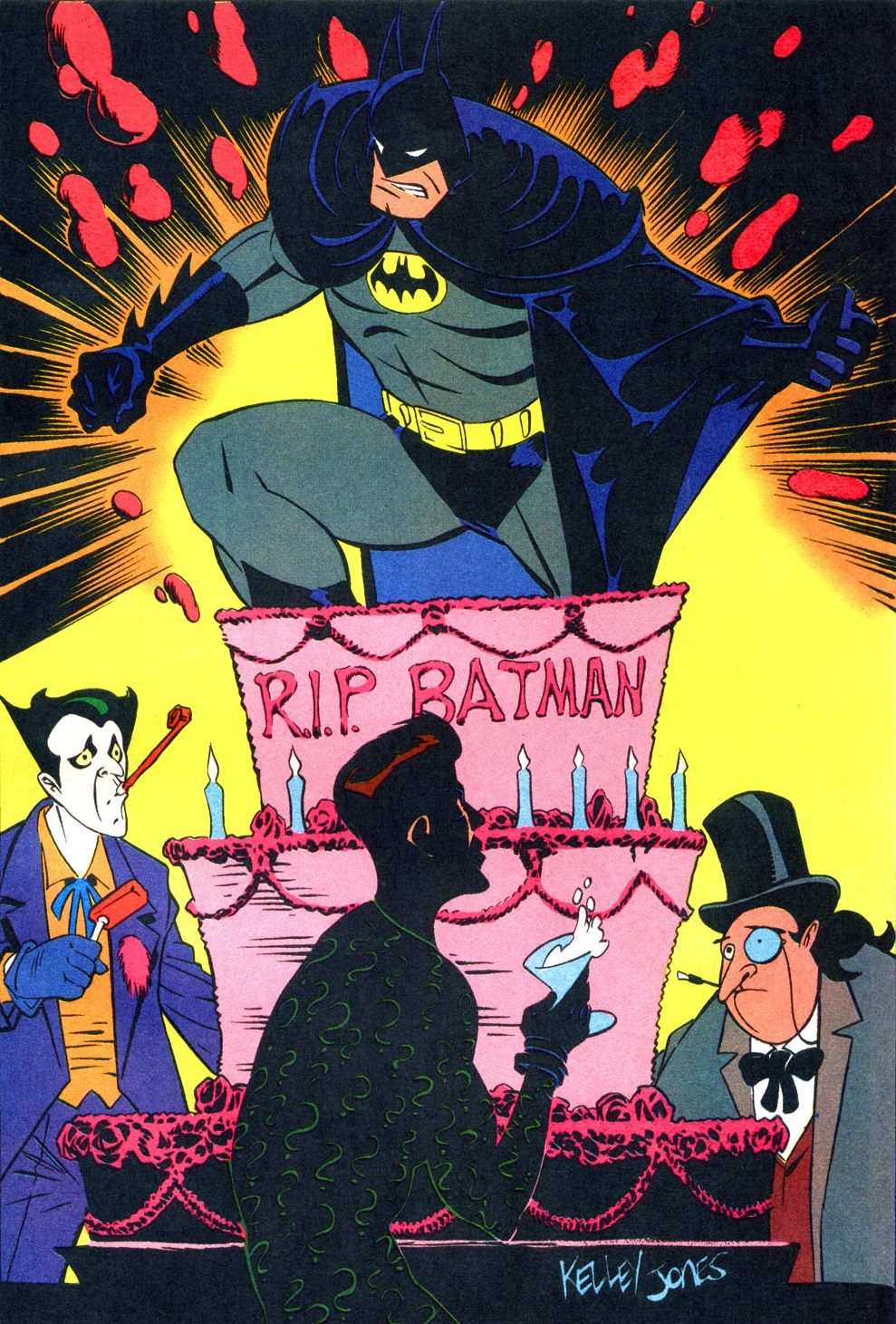
Happy birthday, Denny. Thank you for...well, other than my wife and children, pretty much everything good in my life.